It seems to me that the nomadic past holds a similar place in Kazakh culture as cowboys and frontiersmen do in the American West. Not only does nomadism share the romantic features of freedom, bravery, exploration and nature – nomads in Kazakhstan have the additional attraction of being once a major world power.
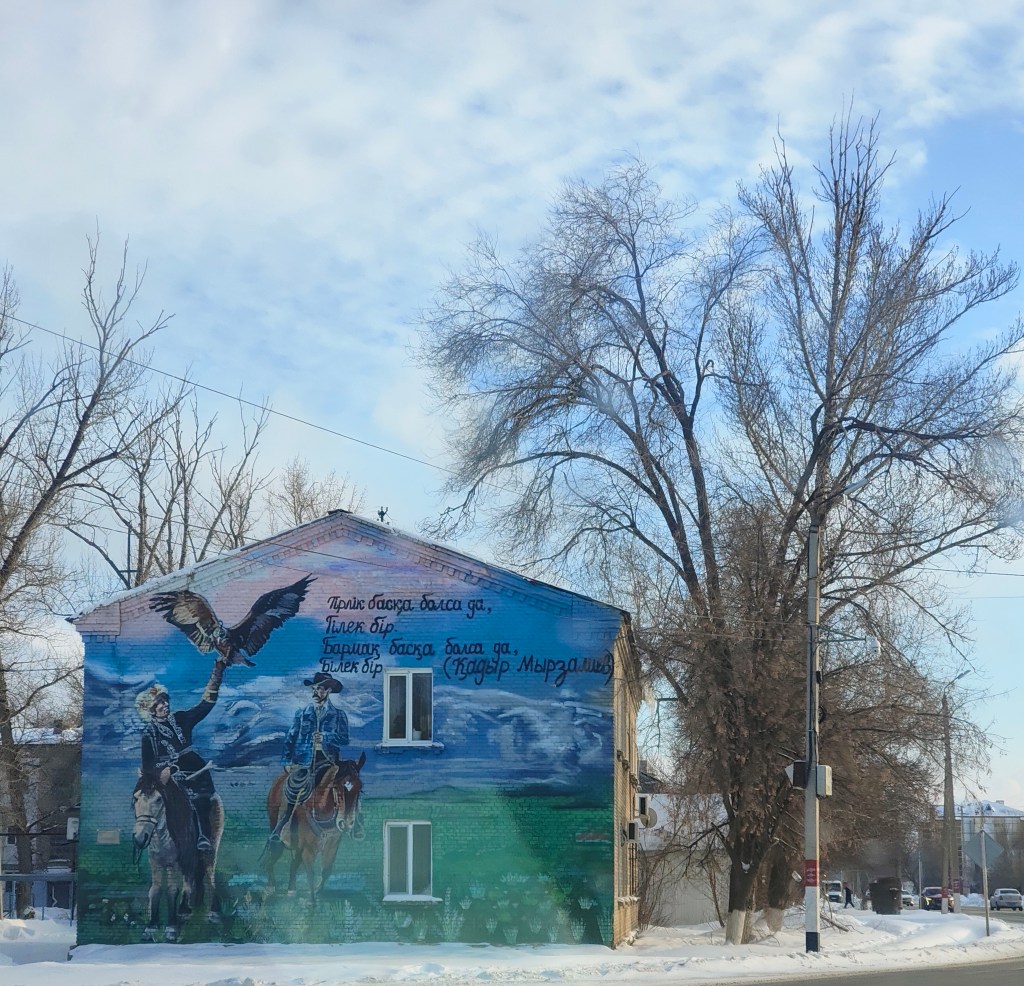
As if painted purely to make the connection for me, here is a mural I photographed in Uralsk of a man on horseback wearing a cowboy hat and denim jacket.
it is not, however, the modern idea of nomadism that interests me here. I’m interested in a much more nuts and bolt attempt to understand how nomadic society actually functioned – how the economy worked, what problems consistently appeared, how culture and institutions adapted to address these problems, etc.
So, armed with a burgeoning interest in anthropology, as well as a curiosity to understand the parts of nomadic heritage that survive in Kazakh culture today, I read Nomads and the Outside World (1994) by Anatoly Khazanov. The book was excellent, albeit very academic (‘magisterial’ is the word that appears on most of the positive reviews, and I’d say fair enough) and it didn’t map exactly onto my areas of interest. The book has a global outlook and a particular thesis that I’ll come back to later, but happily for me, it was written by an author with a particular interest in and knowledge of Central Asian nomads. Anything I quote in this post will be quoted from this book.
Part 1: The Ecological Basis of Nomadism
When we talk about Kazakh nomads, we are not talking about bands of nomadic hunter-gathers, but rather nomads who moved with a herd of animals. Nomadic Pastoralists, in the lingo. Nomadic pastoralism becomes a dominant mode of subsistence in areas that meet the following criteria:
1) Agriculture is difficult on much of the land. Think desserts, semi-deserts, tundras etc.
2) There is a compelling ecological reason to regularly move pastures, rather than establish fixed rotational pastures like sedentary pastoralists would.
As you can imagine, there are many different scenarios that could provide the second cause, and each scenario leads to different migration patterns and ultimately to different cultural adaptations, which makes it quite treacherous to generalise about all nomads globally, but it even makes it difficult to generalise about nomads within Kazakhstan, which might be one of the most ecologically diverse countries on earth. Nevertheless, painting with a broad brush: Kazakh nomads moved south in the winter to escape the snow from covering the fields, and back north in the summer for better water sources. Quoting Khazanov:
The fact that the Eurasian steppe type of nomadism for the most part was situated in a temperate zone was one of the most important in determining the routes and character of pastoral migrations. Except in mountainous regions where vertical migrations either had to take place all year round or else they were seasonal (such migrations were particularly widespread amongst the Kirghiz, certain groups of Mongols, Tuvinians and Uzbeks), migrations were usually regular, linear, [North/South, routes were fairly stable, seasonal changes of pasture were clear-cut and water was the main priority in summer, fodder in the remaining seasons. ‘The fodder requirements of the herd, the necessity of providing it with water and the best way of protecting it from the cold in winter are the basic factors in the economic life of the nomad. The amount of time spent in camps, the direction of migrations, number of pastoral migrations and distance of the latter all depend on those factors’ (Ishchenko ef al., 1928:105). This observation about the Kazakhs can be applied to almost all the other nomads in the Eurasian steppes. Only in certain desert regions, for example amongst the Turkmen, were there radial-circular migrations in which availability of water was the primary concern (Orazov, 1975:217).
He goes on to give an intriguing distinction between the character of various Central Asian migrations:
The distance of pastoral migrations has varied very considerably. Amongst the Mongols of Inner Mongolia it sometimes has been less than 150 kilometres (Lattimore, 1967:73n.21), in the Gobi zone of Outer Mongolia it has amounted to 600 kilometres (Graivoronsky, 1979:49) and amongst the Kazakhs of the Little and the Middle Hordes it has been 1,000—1,500 kilometres (Narody Srednei Azii, 1963:354).
I must confess that before reading this, my vague notion was that nomads spent their days more or less aimlessly wandering between random locations and occasionally bumping into each other – but the reality that they spent much of their time in temporarily fixed camps and bi-annually made a pilgrimage north/south along more or less fixed routes does help clear up the mystery of how social life was possible amongst nomads.
Another point that’s worth making from the ecological point of view is that nomadic pastoralism is the only rational adaptation humans could make to survive in particular environments. This cannot be stressed enough when considering the problems faced by any surviving nomadic cultures today. Whilst the goals of sedentarisation and productive integration of nomads with sedentary society are often laudable (nobody wants the difficult and unstable parts of their way of life preserved as a zoo exhibit for the benefit of other cultures!), it should go without saying that this integration needs to be done with a thorough understanding of the local ecological conditions, and it needs to be done to the benefit of, and with the involvement of, the nomads themselves. The Kazakh example of sedentarisation is illustrative here, if only for the sheer soviet-style brutality of it. Quoting Khazanov again:
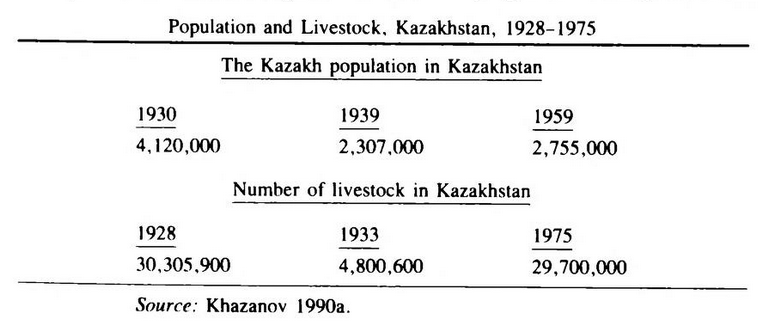
Within a few years the nomads and pastoralists in Central Asia and other areas were forced to sedentarize and enter newly created collective farms, which meant giving up their privately owned livestock. Denomadization and collectivization of the nomads met with widespread opposition. Those who resisted were either killed or deported; some people managed to migrate abroad, many died of starvation. The political aims of the center were achieved; the pastoralists were ‘domesticated,’ but at a heavy cost. Their traditional way of life was ruined and the Soviet economy was seriously damaged.
The Kazakhs, in the past the most numerous nomadic people of the USSR, illustrate these tragic events. In the early 1930s, during the traumatic events of forced collectivization and bloody settlement of Kazakh nomads on fixed lands, about 550,000 nomadic and semi-nomadic households were forced to sedentarize, often in waterless regions where not only agriculture but pastoralism were impossible.
Part 2: Basic Social Structure of Nomads
Comparative materials show that, as a rule, nomadic families are not large and do not usually include more than two generations of adults. In the majority of nomadic societies nuclear families, consisting of a husband, wife and their unmarried sons and daughters, predominate. One variant of this kind of family which is widespread amongst the nomads of the Eurasian steppes, for example, is the patrilocal stem-family in which one of the married sons, usually the youngest, lives with his parents and inherits that part of their property which remains after the rest has been distributed among his elder brothers.
In fact – this pattern of the youngest son remaining with the parents after marriage still predominates in Kazakhstan today. The most defining characteristic of nomadic social structure mirrors the basic physical characteristic of the herd: it’s capacity for fusion or fission. Compare this to the pattern of inheritance in patriarchal-feudal societies: the number one rule for landowners is that they cannot ever divide their land, or else it’s value would dissipate with each successive generation, and so all of the estate traditionally goes to the eldest son (that is to say, feudal lords practice male primogeniture – to the resentment of daughters and second sons alike!).
If married couple splitting away from parents in nomadic society is the basic example of fission taking place, then the various forms of community provide the basic examples of fusion:
One early observer (Levshin, 1832, pt. III:24) wrote: ‘[The Kazakhs] rarely roam in great numbers in one place, for then their herds are crowded; but associations consist of several families which are connected by kinship or mutual need, and they move together from one camp to another and do not separate without specific reason. This mobile village they call an aul; the number of kibitkas in an aul depends on individual circumstances.’ Kazakh auls consisted of 2-4 households, rarely of more than 8 (Semeniuk, 1973:44) right up to the enforced collectivization and sedentarization of the thirties of this century (Briskin, 1929:11). Sometimes such communities of the primary order, which may be called nuclear nomadic communities, coincide with primary kin groups. But this is not always the case. In many nomadic societies communities of the primary order join together in a community of the second order. The members of the latter community use the same pastures and/or water-sources at specific times of year, join up for pastoral migrations, and are linked by various social, kin and other ties, sometimes also by specific forms of mutual aid. […] In some cases several communities of the second order can make up a community of a third order with corresponding rights to natural resources, supplemented by various other ties.
The relative ease with which nomadic units can fuse or separate gave rise to a powerful (and to my mind very attractive) fluidity of social organisation. Nomads could form social orders as big as the great hordes, but the organisation of this was done typically without a single centre of power, in an almost federal way. (Disclaimer: admiring this social structure does not mean I condone all the behaviours of the Kazakh Hordes.)
The most natural ideology for regulating a social structure like this – where mutual obligations exist simultaneously at multiple different levels – is with extended notions of kinship, and so anthropologists refer to it as a Segmentary Lineage system. One evocative way of conceptualising these different tiers of obligation is with the following Bedouin (Arab Pastoralist) saying: “I, against my brothers. I and my brothers against my cousins. I and my brothers and my cousins against the world.”
Another slightly comical way these political notions of kinship can manifest is that it is not unheard of for two groups of nomads wishing to form an alliance to ‘discover’ a fictitious common ancestor in order to legitimate that alliance. There is also a particular Kazakh manifestation of this system that persists to this day: the rule of seven grandfathers. Essentially, everyone is expected to know 7 generations of their patrilineal line (since this is the line on which notions of kinship are conceived) and you are prohibited from marrying anyone who shares any one of these ancestors. Thankfully for my future marriage prospects, although I do not know my patrilineal line beyond 2 generations, I suspect me and Aiko are safe from much overlap. Ultimately though, it is difficult to conceive of this rule as anything other than a mechanism designed to widen kinship alliances, and the fact that the lineage gets traced so far back is testament to the fact that Kazakh political alliances were generally very big!
Part 3: Self-Sufficiency?
The primary thesis of Nomads and the Outside World, which I believe is widely accepted today, is that nomadic pastoralism has never been a completely self-sufficient mode of subsistence. It is non-autarkic, in the lingo. This means that nomadic society has always depended (in one form or another) on ‘neighbouring’ sedentary societies, which always exist alongside nomads, albeit usually in relatively small pockets of fertile land. The main things the nomads need are vegetables and grains but also handicrafts. The nicest way they could acquire these things was through trade, however:
Direct exchange and trade between nomads, on the one hand, and between agriculturalists and townsmen, on the other, essentially involve a number of obstacles which are hard to overcome, particularly if the long history of these relations is taken into account.
[…]
on the one hand, not only the specialization, but also the instability of pastoral nomadism made nomads more interested in trade with the sedentary world; but, on the other hand, this same instability did not favour production of regular surpluses which could have been sold regularly at the market and satisfied the needs of the entire society.
[…]
In the Eurasian steppes the distinctive character of trade between nomads and the sedentary world was determined primarily by two sets of circumstances, one of which was ecological, the other political.
[…]
The fact that agriculturalists and nomads utilized separate ecological zones created specific spatial difficulties for trading. Sometimes livestock and other goods had to be driven and carried over great distances. It is noticeable that it was nomads who played the active role.
The other way of acquiring these goods was through raids, tribute arrangements akin to a mafia protection racket, conquest or partial integration with sedentary society. All of this is pretty straightforward, but it’s worth reflecting on what the distinction between conquest and integration really is. After all, once you’ve conquered a sedentary group, what do you do next? Presumably they remain agriculturalists, but you now periodically extort them for any surpluses they create and come up with whatever legal and cultural arrangements you need to try and to stabilise this exploitative arrangement, including perhaps some concessions to quell the threat of revolt. Now conversely, suppose that part of your community settles somewhere as agriculturalists or semi-nomads (which did in fact happen quite often), but over time the nomadic part of the community make greater and greater demands on the sedentary part, leading to a conflict that the nomads win, and a new arrangement of debt between the sedentary population and the nomadic one.
My point is that ‘conquest’ encourages us to think in purely ethnic terms (‘The Normans conquered the English’ or ‘the Mongols conquered China’), whereas it is often more helpful to think of one segment of society exploiting a different segment of that same society. The relationship between nomads and their conquered agriculturalists was often much more like the relationship between feudal lords and peasants than it was the relationship between a conquered and a conquering state. This is particularly true in Central Asia, which tended more than anywhere else towards large and relatively stable military-political arrangements over vast swathes of territory.
Part 4: Class, Conflict and Hierarchy in Nomadic Society
Internally, nomads never had the sharp, economic, class distinctions that we had in Europe, essentially because herds cannot be monopolised in the same way that land can (and whilst there were definitely notions of private ownership of animals, there were never really notions of private ownership of pastures). There were often slaves of various kinds, usually taken from agricultural populations, but as Khazanov notes (somewhat amusingly):
The employment of slaves in the pasturing of stock or in domestic work was not usually of any essential economic significance, the more so because a nomadic society is not easily able to prevent slaves escaping.
Conflicts between nomads, however, were widespread. At it’s most basic level, this is the result of competition for better pastures and water, the fact that animals are quite easy to steal, and there being little to no central power able to resolve conflicts peacefully. Naturally enough, adaptations to conflict happened according to the social structure described above:
In the eighteenth century a considerable number of Kazakh auls chose to move together on account of the unsettled political conditions surrounding them (Tolybekov, 1959:206). But such associations of several nuclear communities were temporary and collapsed when political conditions were calm (Zimanov, 1958:70-1).
One other significant adaptation most cultures make to a high volume of conflict is that society starts to organise itself around keeping close groups of men together, because men are responsible for most (but by no means all!) of the fighting. Or to describe this adaptation more concretely: after marriage, the woman will always move in with the man’s family, so as not to break up the social bonds between brothers – a practice known as patrilocal residence. By itself, this practice could be fairly benign. However, there are two immediate consequences of it which allow patriarchy to establish itself. The first is that women have a weakened bargaining position in any disputes with their new husband: they have no familial allies around them, whereas the husband is surrounded by familial allies. This is a problem that many women in Kazakhstan still contend with today, since patrilocal residence is still a social norm in the majority of the country (and, just to be clear, this practice does not necessarily lead to bad outcomes for all women involved, nor does having a weakened position totally strip individuals of all potential agency). However, it is increasingly common now for married couples to move out on their own much earlier, and this is more true the more urban you get.
The second problem is how this adaptation changes the relationship between parents and daughters. For nomadic parents, your sons essentially function as your retirement plan, whereas your daughters are sometimes treated as ‘guests’ that must be raised only to inevitably be given away to another family. One traditional mechanism introduced to compensate for this is ‘bridewealth’ (kalym) – which is wealth given by the groom’s family directly to the bride’s family (i.e. the direct opposite of a dowry), although this has never been a ubiquitous practice in Kazakhstan.
Over time, however, this doubly weakened bargaining position of women means that they would lose more conflicts on aggregate than they won – and eventually patriarchal ideologies get instilled (in both men and women) in order to prevent further conflicts whose outcome would be entirely predictable.
One thing that must be stressed here – in case your head is full of European enlightenment rubbish – is that male dominance is not an inevitable feature in all human society up until Europeans spontaneously decide to give women rights (leaving the rest of the world playing catch up) but rather, male dominance is a response to a power imbalance caused by specific material conditions, such as sustained martial conflict. Once established, it is then quite difficult to shift. There are plenty of examples in anthropology of cultures that have developed traditions of matrilineal inheritance, matrilocal residence and subsequently where women occupy most, if not all, the positions of political power. The Native American haudenosaunee (Iroqouis) are perhaps the canonical example, but there are others like The Saharan Tuaregs (who are also nomadic pastoralists!), not to mention all the cultures that have developed along more or less egalitarian gender lines.
Conclusion
There are many other intriguing features common to most nomadic (and nomadic-origin) cultures that I’ve elected not to go into detail on: They often highly value hospitality and they usually love a big party (to speak of two features of modern Kazakh culture that I can attest to).
Still, I have to end this post somewhere and, intriguing as it may be, there is a limit to how much my understanding of nomadic culture will really translate into an understanding of modern day Kazakhstan – which is after all a modern, sedentary country with a vast scope of different influences. That doesn’t mean I’m not going to take every opportunity to get on a horse or sleep in a yurt, though, like the nomadic cowboy I was always destined to be.


Leave a Reply